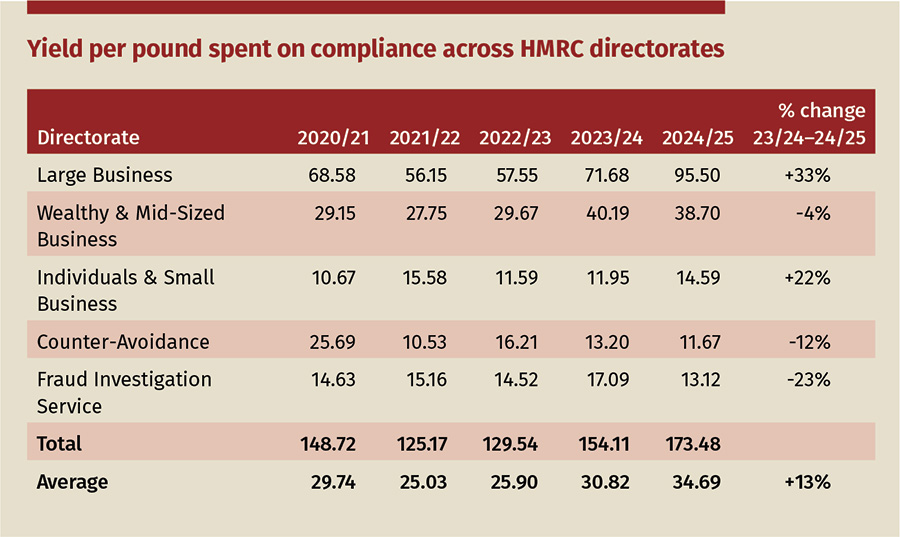
HMRC secured £34.70 in extra tax for every £1 they spent on tax investigations on average across the five key taxpayer directorates in the last year, up 13% from £30.80 the previous year.
The return on investment that HMRC have realised from tax investigations shows why the Chancellor has consistently awarded additional funding to HMRC. The organisation continues to expand compliance activities, including investing in technology.
Large business investigations generated the highest returns per pound spent on staff costs, with the yield rising 33% to £95.50 for every £1 spent, up from £71.70 the previous year.
Part of that rise was driven by the increase in the amount of tax that HMRC have obtained by investigating the UK’s largest businesses on corporation tax compliance. HMRC’s Large Business Directorate’s yield from corporation tax increased by 91% from £3.2bn in 2023/24 to £6.1bn in 2024/25.
The yield from investing in investigations into individuals and small businesses also rose significantly, although not to the same extent, with yield increasing by 22% to £14.59 from £11.95.
HMRC report that the tax risks they are dealing with are increasingly focused on complex and novel areas of tax law. Our experience amongst large corporates matches that conclusion, which requires increasing sophistication in managing disputes with HMRC.
Since 2019, HMRC have been assigning a risk rating to each of the UK’s biggest companies and assigning a senior member of staff to each large business. The approach can be collaborative and enable large businesses to develop better relationships with HMRC. However, there have also been difficulties with the approach, particularly with repeated changes of HMRC staff.
Of the roughly 1,000 largest companies that HMRC have recorded a risk rating during 2024/25, 88 are seen as moderate-high or high risk.
HMRC’s increases in the number of investigations that they undertake are pushing businesses to invest more heavily in compliance and internal controls.
The HMRC activity also means large corporates are increasingly facing difficult decisions as to whether HMRC are pushing too far on a particular tax issue and should be challenged.