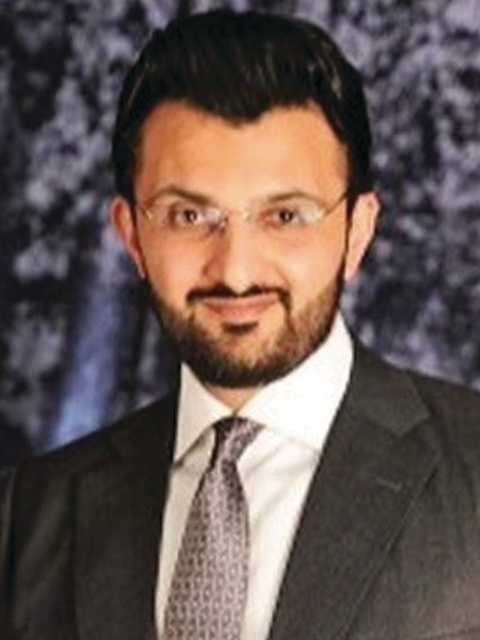
One minute with Imran Afzal KC of Field Court Tax Chambers.
What’s keeping you busy at work?
Recently I have been busy with various litigation related matters, involving a range of topics such as the transactions in securities legislation in ITA 2007 Part 13, and the consequential claims provision in TMA 1970 s 43.
What advice would you give to someone thinking about the Tax Bar?
People sometimes have misconceptions about what life at the Tax Bar involves, for example thinking that it might all be about maths and tax calculations, or that it might be dull and boring. The reality is very different. You might, for example, spend your day thinking about whether a particular item of food is a cake or a biscuit – and you might even want to eat some to inform your thinking! Or, to take another example, you might spend the day on your feet trying to convince the Supreme Court about something.
On a related note, I would say that if you are keen on a career involving litigation, then don’t let that put you off the Tax Bar! I remember that as a student I was initially under the impression that the Tax Bar would mainly involve advisory work, and that whilst there would be some scope for litigation it might not be extensive. However, while it is possible to focus on advisory work at the Tax Bar, it definitely doesn’t have to be that way. People have a range of types of practice at the Tax Bar, with different balances of advisory and litigation work – and the balance can change as your career progresses. So, if you are interested in tax law, and you want to be in and out of the tribunals and courts, then the Tax Bar might be for you!
If you could make one change to tax, what would it be?
As matters presently stand, I think the question of whether the First-tier Tribunal (FTT) can consider public law arguments can be difficult and not straightforward. That is not an ideal situation, and it can create difficulties for taxpayers. It would be extremely helpful if it could be made clear, most likely through legislation, precisely to what extent the FTT can entertain public law arguments.
Indeed, I can see that it might be sensible to go further and provide that the FTT is the normal, possibly exclusive, forum for public law arguments to be raised in a tax context; that should make things simpler, and hopefully also less expensive. For example, if a taxpayer wants to challenge a tax assessment as being incorrect as a matter of general tax law, and also as being in breach of public law principles, then, if the aforementioned change is made, it would be clear that both arguments could be advanced before the FTT – the certainty would be beneficial, and the fact that both arguments could be advanced before the FTT would hopefully result in simplicity and time/cost savings.
You might not know this about me but...
I am a trustee at The Royal Grammar School, High Wycombe Foundation CIO. The RGS is a lovely school, and I was very fortunate to be able to study there. I am delighted that, having left the school (very many!) years ago, I can still be involved with it.
One minute with Imran Afzal KC of Field Court Tax Chambers.
What’s keeping you busy at work?
Recently I have been busy with various litigation related matters, involving a range of topics such as the transactions in securities legislation in ITA 2007 Part 13, and the consequential claims provision in TMA 1970 s 43.
What advice would you give to someone thinking about the Tax Bar?
People sometimes have misconceptions about what life at the Tax Bar involves, for example thinking that it might all be about maths and tax calculations, or that it might be dull and boring. The reality is very different. You might, for example, spend your day thinking about whether a particular item of food is a cake or a biscuit – and you might even want to eat some to inform your thinking! Or, to take another example, you might spend the day on your feet trying to convince the Supreme Court about something.
On a related note, I would say that if you are keen on a career involving litigation, then don’t let that put you off the Tax Bar! I remember that as a student I was initially under the impression that the Tax Bar would mainly involve advisory work, and that whilst there would be some scope for litigation it might not be extensive. However, while it is possible to focus on advisory work at the Tax Bar, it definitely doesn’t have to be that way. People have a range of types of practice at the Tax Bar, with different balances of advisory and litigation work – and the balance can change as your career progresses. So, if you are interested in tax law, and you want to be in and out of the tribunals and courts, then the Tax Bar might be for you!
If you could make one change to tax, what would it be?
As matters presently stand, I think the question of whether the First-tier Tribunal (FTT) can consider public law arguments can be difficult and not straightforward. That is not an ideal situation, and it can create difficulties for taxpayers. It would be extremely helpful if it could be made clear, most likely through legislation, precisely to what extent the FTT can entertain public law arguments.
Indeed, I can see that it might be sensible to go further and provide that the FTT is the normal, possibly exclusive, forum for public law arguments to be raised in a tax context; that should make things simpler, and hopefully also less expensive. For example, if a taxpayer wants to challenge a tax assessment as being incorrect as a matter of general tax law, and also as being in breach of public law principles, then, if the aforementioned change is made, it would be clear that both arguments could be advanced before the FTT – the certainty would be beneficial, and the fact that both arguments could be advanced before the FTT would hopefully result in simplicity and time/cost savings.
You might not know this about me but...
I am a trustee at The Royal Grammar School, High Wycombe Foundation CIO. The RGS is a lovely school, and I was very fortunate to be able to study there. I am delighted that, having left the school (very many!) years ago, I can still be involved with it.