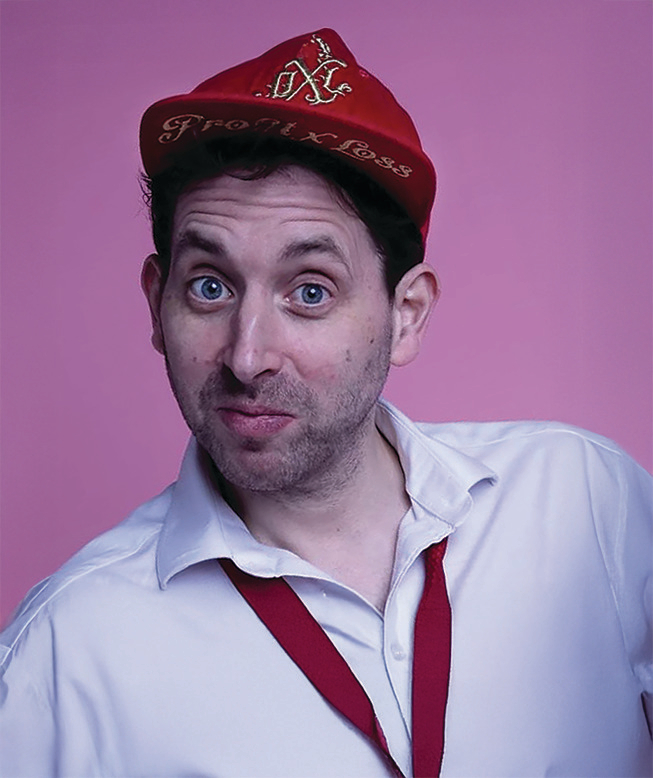
How did ‘The Rebel Accountant’ come about – and how does it fit alongside your day job now?
Back in 2009, while I was working on my record label, I released my first online album, The Rebel Accountant. At first, I kept it separate from my day job because I wasn’t sure how it would be perceived. More recently, I was encouraged to bring the two together. That shift is what’s keeping me busy: balancing client work with creating new material, as well as keeping up with the interest it’s been getting.
You’ve performed tracks such as ‘Dear HMRC’ and ‘Forgot About VAT’. What are you trying to achieve with your rap music, and how have clients responded?
The aim of The Rebel Accountant is to change the narrative about tax through the medium of rap – crazy, I know. But something needs to be done. There is so much misinformation about tax, and it’s leading to terrible decisions and harming the country. Whilst everyone seems to be talking about tax at the moment – economists, journalists, some guy called Gary – none of them are tax experts. We need specialists to explain what will work or not.
The reaction from clients has been absurdly positive. I’m actually working on my next song at the moment – ‘Can’t tax this’ (to the tune of ‘Can’t touch this’) – which is about tax havens.
If you could make one change to tax, what would it be?
We need to wake up and start being bold. Statistically speaking, the rich are almost all self-made entrepreneurs – we need to create a system that supports rather than punishes them. It’s unsurprising that the UK’s wealthiest people are fed up, vilified and leaving. What we need is an economy on fire, and to do that you need to let the entrepreneurs fly. Plenty of countries have proven that low taxes can lead to high economic growth: Ireland, Singapore, Dubai, the States. Ultimately, we have to make the UK itself more attractive.
A more tangible thing I’d change is stealth taxes. People don’t really understand them, and they creep up quietly in the background while the big headline taxes grab attention.
If I had a magic wand, I’d start by stripping a lot of this back until it actually makes sense again, and then rebuild it properly. Take VAT: we shouldn’t ignore it, because it could do so much more, especially now we’ve got the freedom post-Brexit to rethink it.
I’d look at introducing a graduated VAT system based on the size of the business, so instead of hitting a cliff edge at £90k, you ease it in – 5% at that level, 10% at £150k, and so on – which would actually help businesses grow rather than holding them back. Then I’d take a proper look at zero-rating and clearly define a core set of essentials that should always be accessible – food, clothes, even a bottle of wine – so everyone can afford the fundamentals. I’d then balance that by putting higher rates on the things we know are more discretionary, such as fast food, fast fashion and luxury goods. Nothing extreme, maybe 22% or so, but if we’re going to tax consumption, it should fall more on those who can actually afford it.
What mistakes do you most often see from clients – and from HMRC?
For clients, the most common mistake is forgetting about VAT, as well as taking a little information from the HMRC website or ChatGPT (other AI tools are available) and assuming it is the law.
HMRC’s most common mistake is treating SMEs like large companies that can afford the ever-increasing compliance costs, and penalising them when things go wrong.
You might not know this about me but...
Okay, so you already know I rap. I also have a podcast called Business without BS. But what makes me really happy is writing music with my amazing wife. We collaborate at the Rebel Accountant and Doctor Square (she’s a GP, and anything but square).
How did ‘The Rebel Accountant’ come about – and how does it fit alongside your day job now?
Back in 2009, while I was working on my record label, I released my first online album, The Rebel Accountant. At first, I kept it separate from my day job because I wasn’t sure how it would be perceived. More recently, I was encouraged to bring the two together. That shift is what’s keeping me busy: balancing client work with creating new material, as well as keeping up with the interest it’s been getting.
You’ve performed tracks such as ‘Dear HMRC’ and ‘Forgot About VAT’. What are you trying to achieve with your rap music, and how have clients responded?
The aim of The Rebel Accountant is to change the narrative about tax through the medium of rap – crazy, I know. But something needs to be done. There is so much misinformation about tax, and it’s leading to terrible decisions and harming the country. Whilst everyone seems to be talking about tax at the moment – economists, journalists, some guy called Gary – none of them are tax experts. We need specialists to explain what will work or not.
The reaction from clients has been absurdly positive. I’m actually working on my next song at the moment – ‘Can’t tax this’ (to the tune of ‘Can’t touch this’) – which is about tax havens.
If you could make one change to tax, what would it be?
We need to wake up and start being bold. Statistically speaking, the rich are almost all self-made entrepreneurs – we need to create a system that supports rather than punishes them. It’s unsurprising that the UK’s wealthiest people are fed up, vilified and leaving. What we need is an economy on fire, and to do that you need to let the entrepreneurs fly. Plenty of countries have proven that low taxes can lead to high economic growth: Ireland, Singapore, Dubai, the States. Ultimately, we have to make the UK itself more attractive.
A more tangible thing I’d change is stealth taxes. People don’t really understand them, and they creep up quietly in the background while the big headline taxes grab attention.
If I had a magic wand, I’d start by stripping a lot of this back until it actually makes sense again, and then rebuild it properly. Take VAT: we shouldn’t ignore it, because it could do so much more, especially now we’ve got the freedom post-Brexit to rethink it.
I’d look at introducing a graduated VAT system based on the size of the business, so instead of hitting a cliff edge at £90k, you ease it in – 5% at that level, 10% at £150k, and so on – which would actually help businesses grow rather than holding them back. Then I’d take a proper look at zero-rating and clearly define a core set of essentials that should always be accessible – food, clothes, even a bottle of wine – so everyone can afford the fundamentals. I’d then balance that by putting higher rates on the things we know are more discretionary, such as fast food, fast fashion and luxury goods. Nothing extreme, maybe 22% or so, but if we’re going to tax consumption, it should fall more on those who can actually afford it.
What mistakes do you most often see from clients – and from HMRC?
For clients, the most common mistake is forgetting about VAT, as well as taking a little information from the HMRC website or ChatGPT (other AI tools are available) and assuming it is the law.
HMRC’s most common mistake is treating SMEs like large companies that can afford the ever-increasing compliance costs, and penalising them when things go wrong.
You might not know this about me but...
Okay, so you already know I rap. I also have a podcast called Business without BS. But what makes me really happy is writing music with my amazing wife. We collaborate at the Rebel Accountant and Doctor Square (she’s a GP, and anything but square).